


BLOG
AI needs boundaries, not autonomy
Most organizations already know that AI can speed up software delivery. The problem is that it also might speed up the accumulation of technical debt. This article looks at why the "AI as autonomous developer" model breaks down, and what a better approach looks like in practice.
This article is the second part of a series on why AI in software development fails to deliver on its promises.

AI is not a developer
More organizations are stepping back from treating generative tools as autonomous programmers. Instead, they embed AI models, LLM calls and agents, inside controlled workflows alongside deterministic automations. In this setup, AI is part of a governed architecture. It handles execution. It doesn't make architectural decisions. Every suggestion goes through review, validation, and approval. Human-in-the-loop by design, not as an afterthought.
This is what a Business Process Automation platform and BOAT (Business Orchestration and Automation Technology) platform gives you: delivery speed without losing control. Standardized components, defined approval paths, clear ownership. AI operates inside your governance model, not around it, and stops generating unchecked technical debt in the background.
This is what it looks like when it works
AI embedded in a workflow is a sequence of concrete steps. Take invoice processing. An AI agent reads a scanned document, extracts amounts, dates, and VAT numbers, and pre-fills the form. The process then routes automatically for approval.
Here's how it works:
- AI extracts the data
- The workflow routes it for approval
- A Human reviews exception
- The platform tracks every step
Nobody copy-pasted sensitive data into a public LLM. Nobody manually keyed in the invoice data. And when something goes wrong, you know exactly where and why.
IT controls which model runs in which automation. Data stays inside the platform. Every AI action gets logged and timestamped, tied to a process outcome. You can see what's working, what needs tuning, and what isn't adding value.
Platform-first model as a solid foundation for AI
If you want AI to improve your competitive position, it can't operate outside how your organization builds and changes systems. You need clear boundaries: architecture, quality standards, and change management baked in, so speed doesn't come at the cost of predictability.
A platform approach based on BPA/BOAT lets you embed language models and AI agents in a controlled environment. Inside your workflows. With built-in security, audit trails, and approval gates. AI doesn't replace your architecture − it works within it.
That also lowers the barrier to entry. Organizations without large engineering teams can use AI safely because governance and predictability are built into how the platform works. You get order by default, not by hoping someone follows the guidelines.
That's exactly what we built WEBCON around. See the infographic below to check how WEBCON supports AI deployment directly inside your processes.
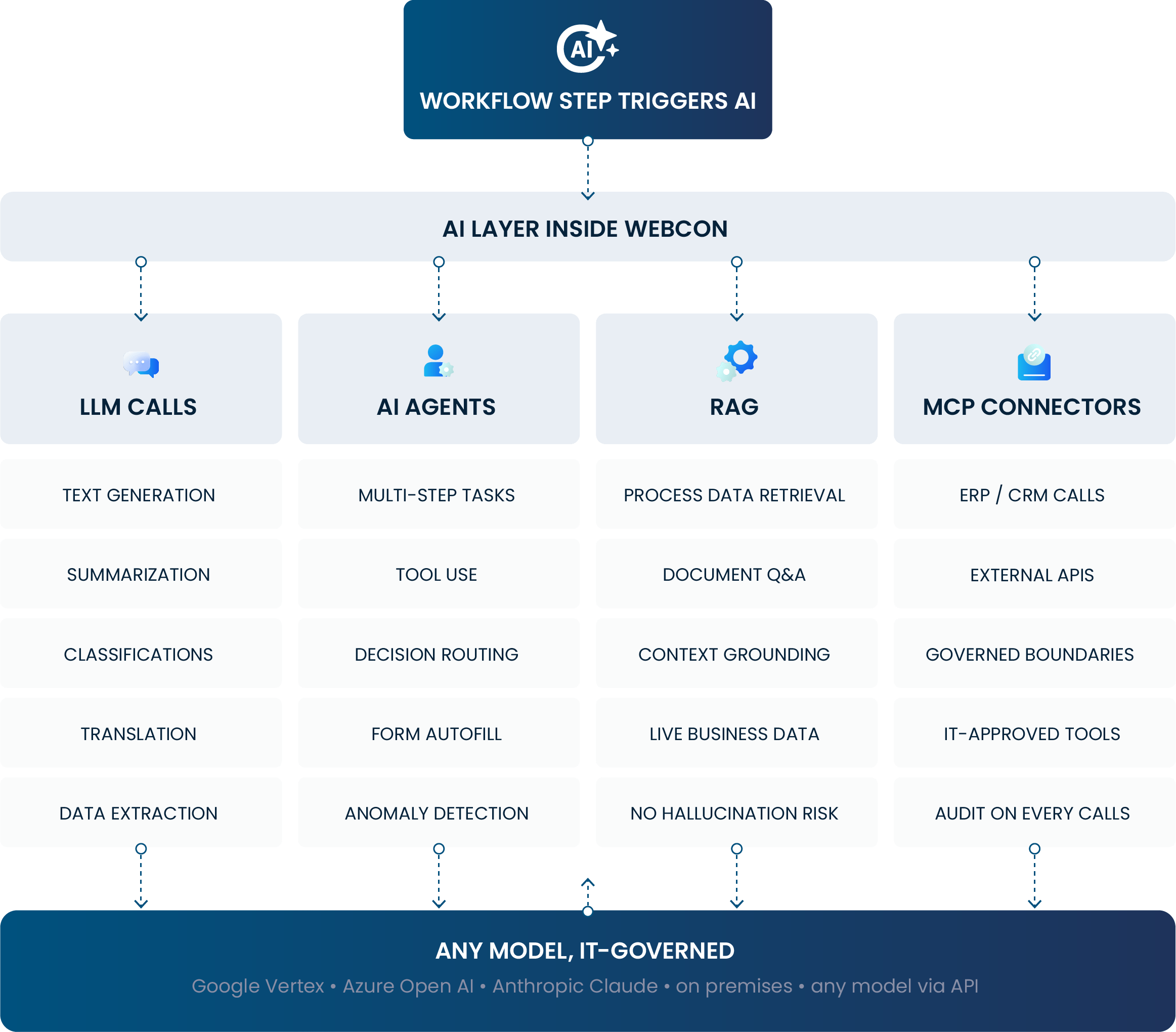
See how you can get AI down to business. And if you want to talk through what this looks like for your organization, get in touch.
Blog
Read also

AI without lock-in: plug any model into your business processes
WEBCON connects to models from Google, OpenAI, and Azure. You pick the right model for each task, swap anytime, and keep your process logic intact.

How WEBCON uses the MCP: secure AI integrations from day one
WEBCON uses the Model Context Protocol (MCP) to connect AI with your existing processes. No new endpoints, no extra development.

WEBCON’s AI Agents: your invisible helping hand
WEBCON AI agents read, classify, translate, and analyze documents inside your workflows. Learn how they turn manual process steps into autonomous actions.