


BLOG
Why It’s Worth Integrating ERP Systems with Applications Built in WEBCON
Many companies using Enterprise Resource Planning (ERP) solutions, such as SAP, IFS, and Microsoft Dynamics, choose to enhance them with an external BPMSclass platform. For many organizations, this process solution becomes the primary interface for most employees, while all other operations run behind the scenes, thanks to seamless integration with other systems used within the company (including ERP, CRM, and other domain-specific applications). Here are five key motivations driving this decision.

Michał Rykiert
Chief Evangelist EMEA at WEBCON
Bringing over a decade of expertise in the realm of Information Technology, I’ve had the privilege of actively contributing to diverse facets of digital transformation. I’ve been working closely with clients and business partners across the world. From shaping strategies to delivering projects and witnessing their success, my experiences have equipped me with insights into both technology and human dynamics. My expertise lies in the realms of business process management, optimization, and automation through the utilization of low-code solutions.
1. Accelerated Time-to-Market for Process Solutions
While ERP systems excel in enterprise resource planning, many organizations recognize the need for rapid deployment of applications that effectively support various ancillary activities and processes. In this context, WEBCON customers report high satisfaction levels, as implementing new processes based on the platform takes them 2 to 5 times less time compared to alternative solutions. This capability not only enhances the efficiency of the organization’s back office but also builds a competitive advantage by quickly delivering innovative solutions.
2. Flexibility and Customization
It is essential to highlight the significance of customizing process solutions not only to the execution methods within specific industries but also to the unique characteristics of individual organizations. While processes like invoice approvals, order handling, and Bill of Material management may appear standard, each organization executes them differently.
Many companies find that ERP systems (including SAP) often require them to conform to predefined patterns or undertake costly customizations. In contrast, WEBCON clients enjoy complete freedom to model their business processes. Additional tools, such as Designer Desk, empower businesses to take control of their processes in a straightforward and understandable manner.
ERP Integration Example: WEBCON and SAP
For many years, WEBCON has successfully integrated with SAP solutions, including SAP ECC, SAP S/4HANA, and SAP One Business. This integration is bidirectional, allowing for data retrieval from SAP as well as the sending of data and documents back to SAP within executed processes.
On the WEBCON side, integration is accomplished through universal connectors. For newer SAP instances, integrations typically utilize a dedicated connector for REST Web Services. Due to technical limitations, integration with older SAP installations is performed using SOAP Web Services. In addition to direct integration with SAP, WEBCON also facilitates information exchange via data buses, which is commonly achieved through Web Services.
Custom integrations can also be configured using the SDK module, offering complete flexibility in the scope of integration. Furthermore, WEBCON clients and partners often utilize third-party platforms designed for SAP integration, such as yunIO, which are particularly beneficial when clients lack internal SAP expertise.
3. Rapid and Efficient Change Management in Running Applications
Another factor motivating companies with ERP systems to adopt an extensive network of process applications in WEBCON is the speed and ease of implementing changes and improvements to already running applications. While many systems can take weeks or even months to implement changes, WEBCON, through its InstantChange™ technology, ensures high efficiency in evolving existing applications. This process can be conducted via an advanced application lifecycle management mechanism (DEV-TEST-PROD) and, when necessary, through critical ad-hoc changes. In both cases, modifications to applications occur several times faster compared to ERP systems, enabling organizations to swiftly respond to changing business conditions.
4. Cost-Effective Implementation of Multiple Business Applications
The motivations outlined above directly influence the costs associated with implementing business applications. Short implementation times, ease of introducing changes, and low maintenance costs for deployed processes are the primary reasons cited by our clients for adopting the process platform alongside their ERP systems.
Many organizations using WEBCON deploy dozens of business applications annually across various areas such as HR, finance, sales, marketing, and automation of operational processes. This applies not only to back-office but also to industry-specific processes (e.g., quality management in manufacturing or handling leasing processes in finance). As a result, they maximize their return on investment in the BPMS platform.

5. Relieving the ERP System
A key technical reason why many organizations choose to separate business processes from ERP systems is to avoid excessive growth that could transform them into complicated monoliths within the IT ecosystem.
While ERP systems offer extensive functional capabilities, overly broad development—particularly excessive customization—can lead to challenges with regular updates and compatibility across modules and interfaces. Additionally, in cloud solutions, clients often face mandatory system updates, which can render previously created components inoperable and require fixes.
Consequently, IT departments actively work to ensure that ERP systems are primarily used for their core functions while business processes are managed by external low-code platforms like WEBCON..
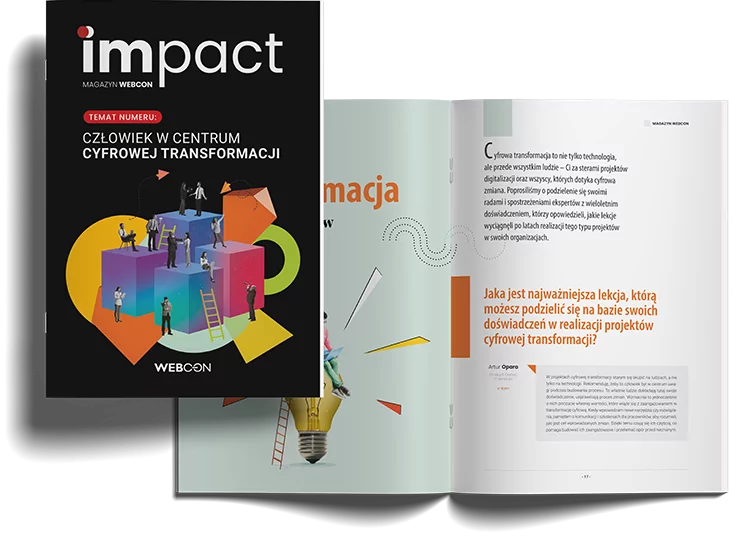
WEBCON Magazine: Impact
Explore the second edition of Impact, an exclusive magazine dedicated to digital transformation. In this issue, you’ll find insightful interviews with WEBCON leaders, in-depth analyses of the company’s development, and inspiring success stories from clients and partners who have created cutting-edge solutions using WEBCON . Get ready for an inspiring read that’s just a click away!
Blog