


Integration
A single platform to create a genuine digital ecosystem
To manage business processes end-to-end, you need to integrate with existing systems. With all systems operating in unison, your information is not duplicated, and is utilized and coordinated more effectively.
The vast integration capabilities of WEBCON allow you to unify and manage your entire IT environment, all without the need for coding.

Join the global leaders who trust WEBCON


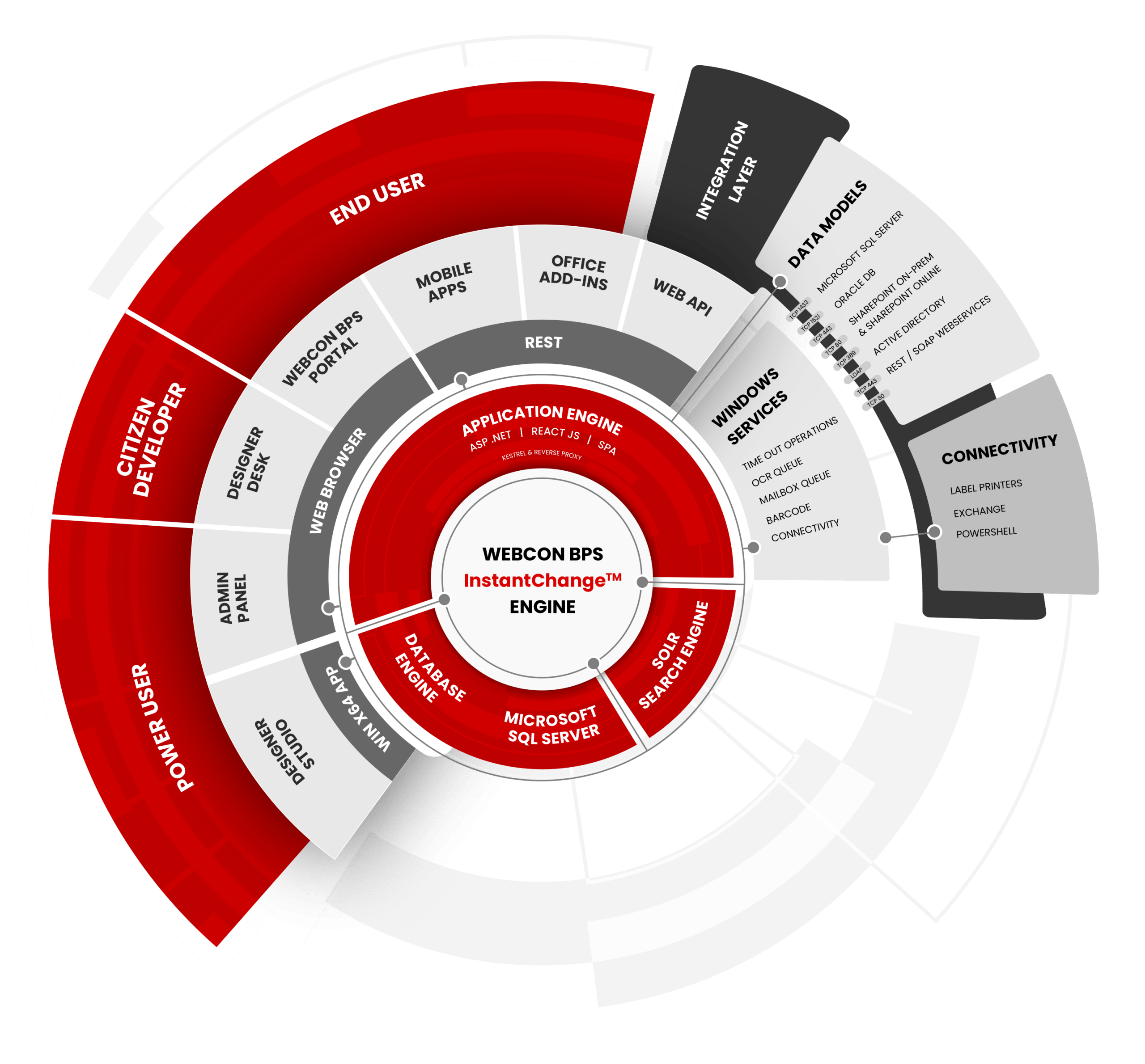
WEBCON data models
Power users can create data models to be used in exchanging information between business applications created in WEBCON and external IT systems.
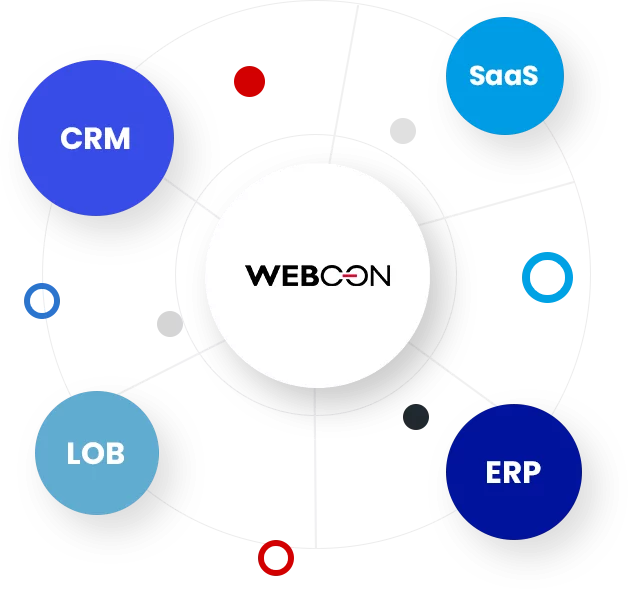
You can then use these data models to easily create business applications that exchange data with ERPs, CRMs and other LOB solutions.
Integration in the application’s delivery lifecycle
The application delivery lifecycle requires connecting to the development, testing and production environments of your external systems, e.g. ERP. We’ve got it covered.
When building applications, WEBCON automates data routing between these environments when you advance from development to test to production.


Data models in multiple business entity scenarios
Having multiple business entities quite often means you have multiple Active Directory domains to maintain. WEBCON supports AD forests and federated domains, providing smart caching mechanisms that keep response times short. But that’s not all.
A multi-entity environment usually results in a number of versatile ERPs (and other data sources) that need to be integrated with one another. WEBCON enabled you to design process-centric applications to standardize and unify business processes across all business entities. Our platform allows for automatic routing of integration mechanisms, based on the context of a business entity.
How does WEBCON accomplish this? The system automatically uses the proper data model based on the credentials of a logged-in user. For example, when querying your list of vendors in the context of headquarters, WEBCON may use a web service to SAP, but obtaining the same list of vendors in the context of a branch office, it may query a SQL view of its Microsoft Dynamics AX.
Out-of-the-box connectivity
WEBCON provides built-in connectors that allows intuitive, no-code creation of data models for:
- Oracle DB and Microsoft SQL Server databases
- SOAP/REST web services (e.g. SalesForce, Microsoft Dynamics)
- Microsoft Active Directory and Azure Active Directory
- Microsoft SharePoint Server and Microsoft SharePoint Online
- Microsoft 365
Additional integrations and data models can be prepared by power users and the possibilities are endless.

Proven integration capabilities
WEBCON has been successfully integrated with many global and local, standard, custom-made, and legacy systems, including:



Blog
Read the Latest Posts
-

Only 45% of IT leaders hit their goals. Can dynamic architecture change that?
When plans have a coin flip chance of surviving a rapidly changing business reality, companies need room to change course. That is why their architecture has to be dynamic.
-

Your data, usable by AI. RAG in WEBCON
RAG connects AI to your own business data, so agents answer straight from your policies and procedures. See how it works in WEBCON.
-
Can a prompt control an AI agent?
A Gartner APPS 2026 recap on AI agent governance: why prompts are not enough and how business processes enforce permissions, approvals and audit trails.


have Questions?
Contact us!
Want to learn more about how we support our clients?
Schedule your free online platform demo or tell us about your business needs and let’s discuss how we can address them with our platform.